SAE Engineering works in materials and manufacturing engineering: deciding which material and process a part should be made from, how it should be inspected, and why it failed when it did. The weight of these decisions shifts from sector to sector; below is a summary of the questions that dominate each field and the technical notes on this site that address them.
Aviation
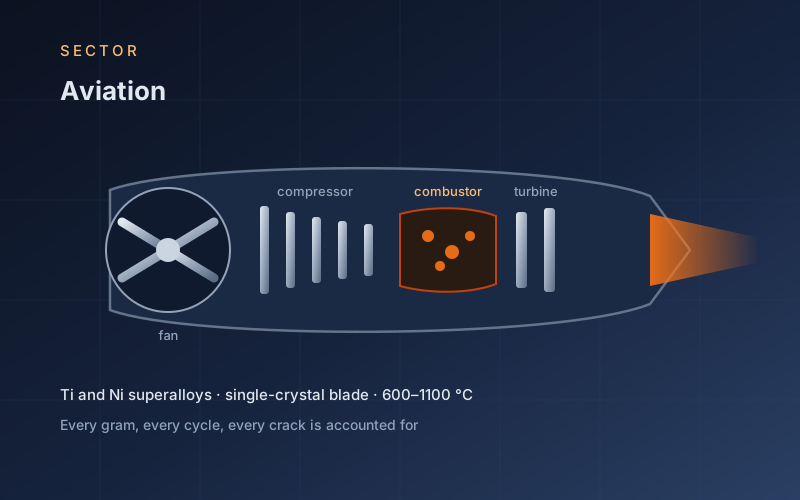
In aviation, weight is fuel and range, so aluminium (2xxx/7xxx), titanium (Ti-6Al-4V) and composites lead. Weight saving alone is not enough: every part must be documented for fatigue life and damage tolerance, and traceable through material certificates (EN 10204 3.1) and heat-treatment records. Typical topics: alpha-case formation and post-machining surface integrity in titanium, precipitation hardening and temper selection in aluminium, preload and torque control in fasteners. Related notes: Titanium Alloys, Aluminium Alloys, Fatigue and Life Estimation, Fracture Mechanics, Non-Destructive Testing.
Automotive
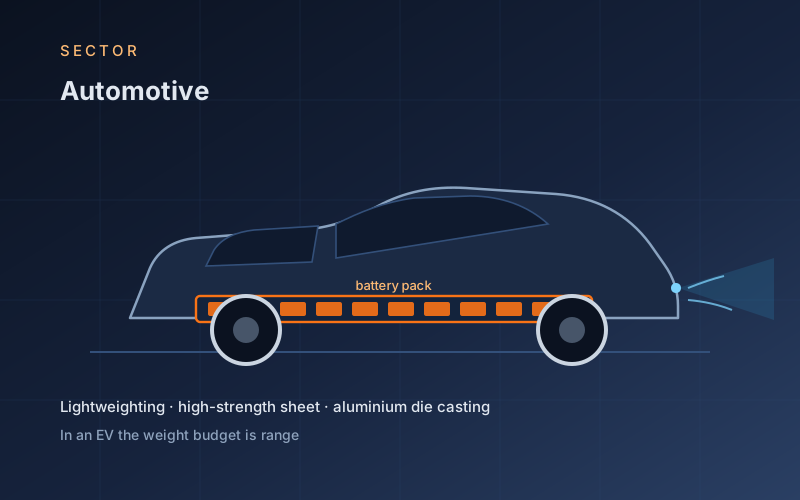
In automotive, cost and cycle time rule: for parts made by the million, the choice between casting, forging, sheet forming and powder metallurgy sets unit cost and quality consistency. Driveline parts bring case depth in carburising/nitriding, surface roughness on gears and shafts; chassis and suspension parts combine fatigue with corrosion. In welded structures the balance between heat input, HAZ hardness and crash performance, and dissimilar-metal joining in aluminium bodies, are recurring subjects. Related notes: Casting Technology, Forging Technology, Heat Treatment of Steels, Surface Treatments, Welding Metallurgy, Tribology.
Defence
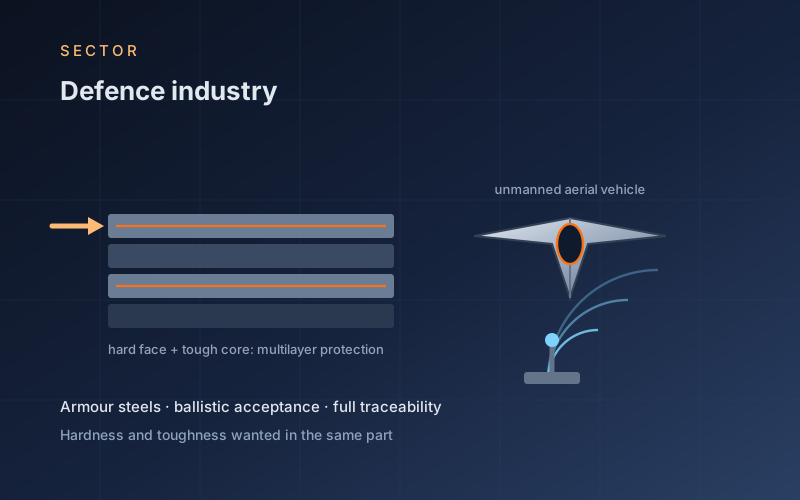
Defence hardware often runs at the extremes: high-velocity impact, shock loading, wide temperature ranges and long storage life. Armour steels demand a hardness–toughness balance that survives welding; barrels and mechanisms face wear and fatigue; forged munition bodies rely on grain flow and strict NDT acceptance criteria. On the supply side, material equivalence (EN–AISI–MIL cross references) and certificate verification form a workload of their own. Related notes: Steel Selection and Standard Equivalents, Hardness Testing, Mechanical Testing, Failure Analysis.
Space
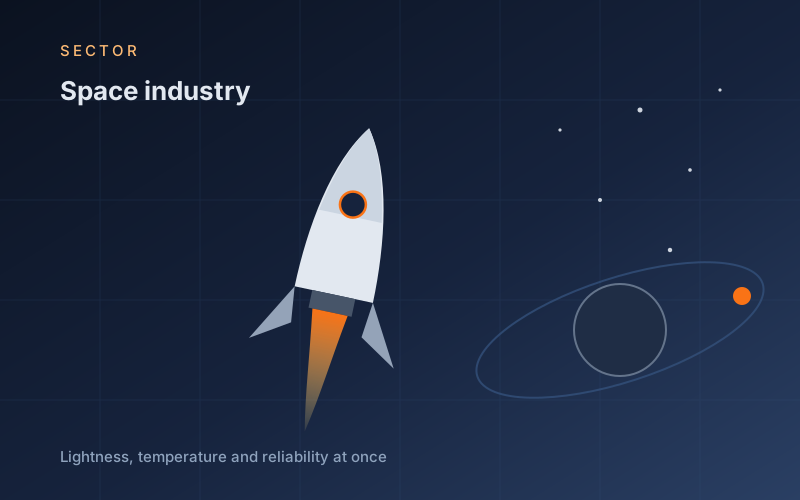
A space component is launched once and never serviced, so materials are chosen by criteria rarely seen on the ground: outgassing, dimensional stability under thermal cycling and cold welding in vacuum. Titanium, nickel-base superalloys, aluminium–lithium alloys and additively manufactured lattice structures are typical choices. In additive manufacturing, porosity, surface roughness and post-heat-treatment microstructure verification are the core of flight qualification. Related notes: Powder Metallurgy and Additive Manufacturing, Metallography, Corrosion and Protection.
Materials science and advanced materials
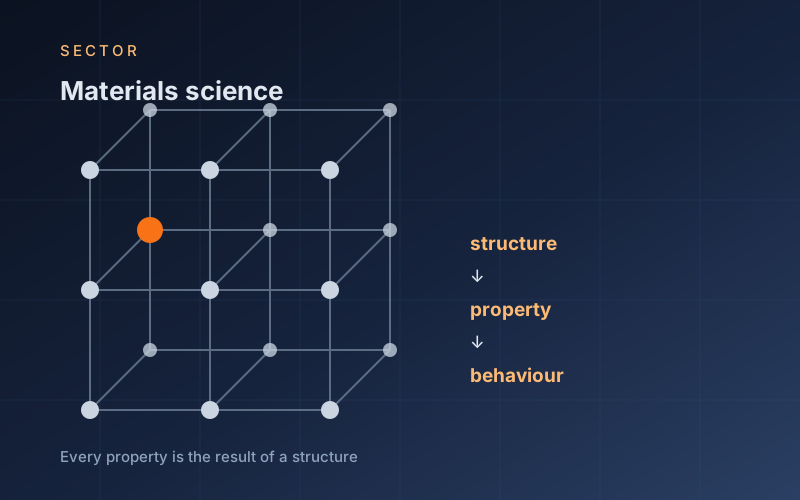
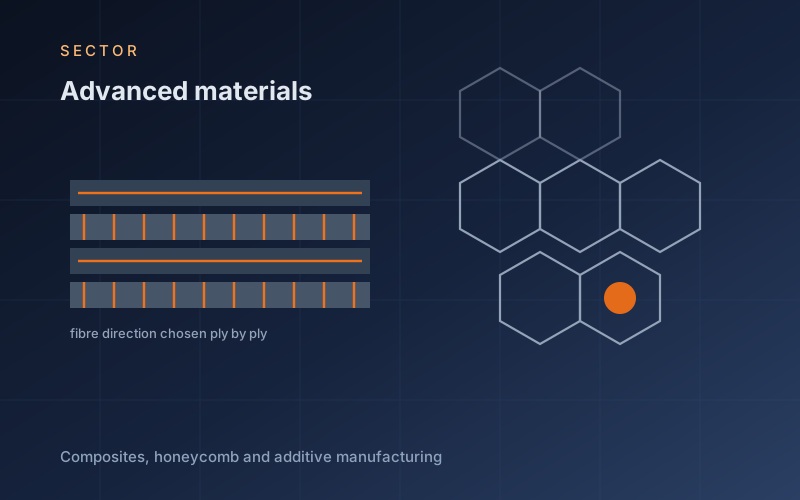
The common ground of all these sectors is the link between microstructure and properties: grain size, phases, precipitates and defects, and how they show up as hardness, strength, toughness and corrosion behaviour. Advanced materials cover semi-solid forming, metal-matrix composites, coating systems (PVD/CVD, thermal spray) and high-entropy alloys. The notes in this area supply the "why" behind a field failure or a design decision. Related notes: Semi-Solid Forming, Metallography and Sample Preparation, Surface Treatments and Coatings.
How we work
Across sectors we take three kinds of work: material and process selection (new design or cost reduction), failure and fractography analysis (root-cause report) and technical second opinion (supplier reports, inspection results, specification reviews). The first assessment is free: a paragraph describing the situation is enough. Request a quote → · All technical notes (PDF) · Calculators and tables