Offering strength close to steel at roughly half the density, excellent corrosion resistance and biocompatibility, titanium is the material of critical applications ranging from jet engines to implants. Its high cost makes the right choice of alloy and process especially important.
What this note covers
- Alpha, beta and alpha-beta alloy classes; the special place of Ti-6Al-4V
- Heat treatment and microstructure-property relationships
- Aerospace structural parts and engine applications
- Biomedical applications and surface treatments
When Titanium Pays for Itself
At 4.51 g/cm³ titanium weighs about 60% of steel while heat-treatable alloys exceed 1000 MPa. Its nanometre-thick TiO2 passive film gives outstanding resistance in seawater and chloride environments, and its lack of reaction with body fluids — biocompatibility — makes it unique for implants. It keeps useful properties to about 600 °C, which opens the compressor section of jet engines.
The price is metallurgical: a reactive extraction route (Kroll process, vacuum melting) and difficult machining make titanium far more expensive than aluminium. The right engineering question is therefore never “titanium?” but “which requirement in this part justifies paying for titanium?”
Alpha and Beta: the Compass of Titanium Metallurgy
Pure titanium transforms at 882 °C from hexagonal α to body-centred cubic β. That temperature — the beta transus — is the reference for every thermomechanical operation.
- Alpha stabilisers: Al, O, N, C raise the transus. Oxygen is also a potent solid solution strengthener — the difference between commercially pure Grades is essentially the oxygen content.
- Beta stabilisers: V, Mo, Nb (isomorphous); Fe, Cr, Mn (eutectoid) bring beta down towards room temperature.
- Neutral: Sn and Zr dissolve in both phases and add strength.
Alloy Classes
| Class | Typical alloys | Character | Main use |
|---|---|---|---|
| Commercially pure, Grades 1–4 | Grade 2 (most common) | Moderate strength (345–550 MPa), best corrosion resistance and weldability | Chemical process equipment, heat exchangers, architecture |
| Alpha / near-alpha | Ti-6242, Ti-8-1-1 | Creep resistance to 550–600 °C | Compressor discs and blades |
| Alpha + beta | Ti-6Al-4V (Grade 5), Grade 23 ELI | Balance of strength and toughness, heat treatable; about half of all production | Airframe parts, fan blades, implants |
| Metastable beta | Ti-10-2-3, Ti-5553 | Highest strength (>1200 MPa), deep hardenability, good forgeability | Landing gear, springs, fasteners |
Microstructure Decides the Properties
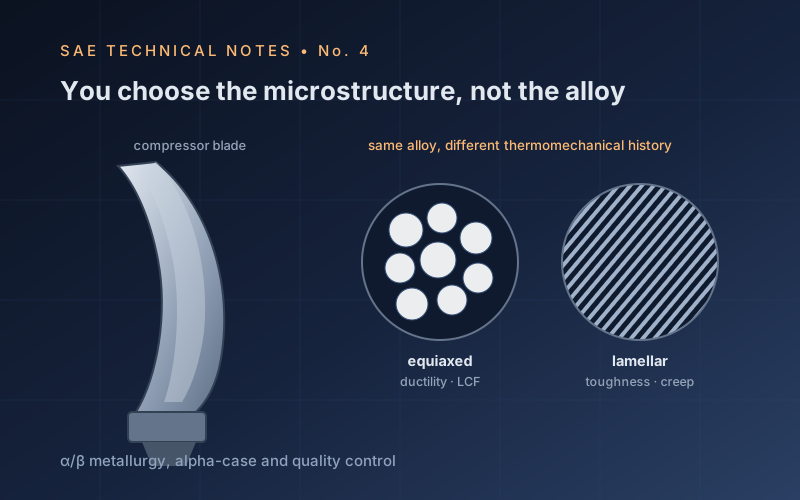
In alpha+beta alloys the microstructure is the direct output of thermomechanical history, and it is selected deliberately:
- Equiaxed (globular) alpha — worked and annealed below the transus. Best ductility and resistance to fatigue crack initiation; weaker in creep and crack growth.
- Lamellar (Widmanstätten, basket weave) — cooled in a controlled way from the beta field. Best fracture toughness, crack propagation resistance and creep; lower ductility.
- Bimodal (duplex) — solution treated in the alpha+beta field and aged. The balance of both, and the standard for engine discs; it requires a narrow process window.
Heat treatments follow the same logic: stress relief (480–650 °C), mill annealing, recrystallisation annealing, beta annealing, and solution treatment plus ageing (for Ti-6Al-4V, roughly 930 °C solution, quench, then ageing at 480–590 °C).
Manufacturing and Machining
Titanium is melted under vacuum (VAR, repeatedly, to avoid hard-alpha inclusions) and is hot worked close to the transus with tight temperature control. In machining, low thermal conductivity keeps the heat in the cutting zone and chemical reactivity attacks the tool: the practical recipe is low cutting speed, high feed, sharp tools, rigid set-ups and generous coolant. Welding is done under full inert shielding — including the back and trailing side — because at temperature titanium dissolves oxygen and nitrogen from the air.
Typical Problems
| Problem | Appearance | Root cause | Prevention |
|---|---|---|---|
| Alpha case | Hard, brittle oxygen-rich surface layer; early fatigue cracking | Oxygen and nitrogen pick-up at high temperature | Vacuum or inert atmosphere, machining allowance, chemical milling |
| Hard-alpha inclusion | Internal indication in UT; hard spot on the fracture | Nitrogen-rich particle in the melt stock | Qualified sponge and revert, multiple VAR, full volume UT |
| Weld contamination | Blue–grey discolouration, brittle bead | Insufficient gas shielding | Trailing and back purge, colour acceptance criteria |
| Hydrogen embrittlement | Delayed cracking, TiH2 platelets | Pick-up during pickling or service (> ~150 ppm) | Controlled pickling, vacuum degassing |
| Galling | Smearing at threaded and sliding contacts | Local rupture of the passive film and cold welding | Anti-seize, dissimilar mating material, surface treatment |
Quality Control and Standards
- Chemistry: oxygen, nitrogen and hydrogen analysis by inert gas fusion — the Grade is effectively defined by oxygen.
- NDT: full-volume immersion ultrasonic testing for rotating aerospace parts; fluorescent penetrant for surfaces.
- Microstructure: alpha grain size and fraction, lamella thickness, alpha-case depth by microhardness traverse, beta transus verification.
- Standards: ASTM B265 (plate), B348 (bar), B367 (castings), F136 / ISO 5832-3 (surgical Ti-6Al-4V ELI), AMS 4911 / 4928 (aerospace), AMS 2801 (heat treatment).
The technical note below (A4 PDF, in Turkish) develops these subjects in depth with original diagrams prepared for this series.