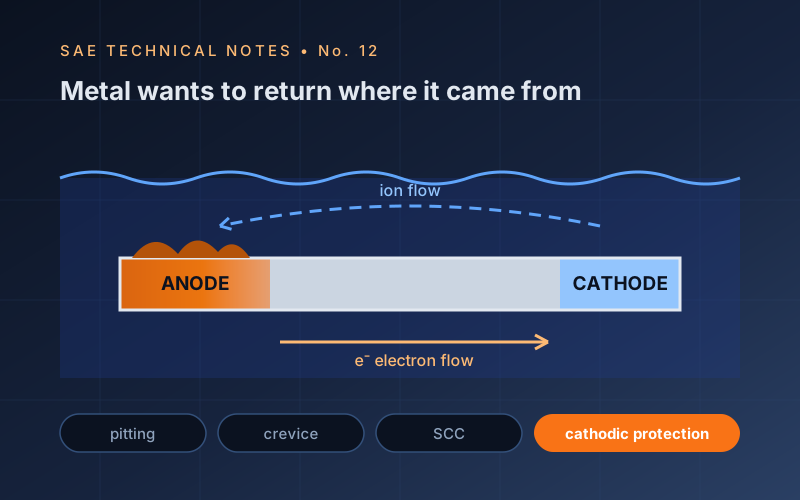
Most metals occur in nature as ore; metallurgy puts energy into those compounds to win the pure metal, and corrosion is the metal giving that energy back as it returns to a compound. Corrosion is therefore not a preventable mistake but a natural process that must be kept at an acceptable rate through the service life. Most failures come not from uniform thinning but from the localised forms that advance without warning.
What this note covers
- Electrochemical fundamentals: anode, cathode, electrolyte and the conductive path
- The galvanic series and the area ratio rule — why a small anode is fatal
- Forms of corrosion: pitting, crevice, intergranular, selective leaching, erosion, graphitic
- Passivity, the pitting potential and stainless steel selection by PREN
- Stress corrosion cracking: the three conditions and the classic material-environment pairs
- Corrosion rate (mm/year), ISO 9223 corrosivity categories and the limits of salt spray testing
- Coatings, cathodic protection (sacrificial anode / impressed current) and inhibitors
- Protection by design: drainage, crevices, dissimilar metal insulation, access
Corrosion Is Not a Material Defect but a Return to Equilibrium
Most engineering metals are produced from oxides with a large energy input. Corrosion is simply the metal going back to the state it came from, and in an electrolyte it does so electrochemically. That is good news for the engineer: a process driven by a measurable potential difference can be interrupted deliberately — by changing the material, the environment, the geometry or the potential itself.
The Electrochemical Basis
Four elements are always needed: an anode where metal dissolves, a cathode where the complementary reaction (oxygen reduction or hydrogen evolution) occurs, an electrolyte and a metallic path between them. Breaking any one of the four stops corrosion — which is why a coating (removes electrolyte contact), an insulating washer (breaks the metallic path) and cathodic protection (forces the potential) are all legitimate and complementary solutions.
The Galvanic Series and the Area Ratio
When two different metals are coupled in an electrolyte, the less noble one corrodes faster than it would alone. In seawater the order runs roughly from magnesium, zinc and aluminium (anodic, sacrificial) through steel and cast iron, to stainless steels, copper alloys, titanium and graphite (cathodic, noble).
Forms of Corrosion
| Form | How it is recognised | Critical point |
|---|---|---|
| Uniform | Even loss of thickness | The most benign: predictable, allowed for by a corrosion allowance |
| Pitting | Deep, narrow pits under a nearly intact surface | Dangerous: little weight loss, rapid perforation |
| Crevice | Attack inside gaps, under gaskets, washers and deposits | Starts at lower chloride levels than pitting |
| Galvanic | Attack concentrated at the junction of two metals | Governed by the area ratio |
| Intergranular | Attack along grain boundaries; the part loses strength while looking sound | Sensitised stainless steel, welded zones |
| Erosion–corrosion | Grooves and horseshoe pits facing the flow | High velocity, turbulence at elbows and pump inlets |
| Stress corrosion cracking | Branched cracks with almost no deformation | Needs the specific combination of alloy, environment and tensile stress |
Passivity, Pitting and PREN
Stainless steels, aluminium and titanium owe their resistance to a thin, self-repairing passive film. The film is broken locally by chlorides, and where it cannot repair, a pit starts and acidifies itself. The resistance of a stainless grade to this is summarised by the pitting resistance equivalent number:
PREN = %Cr + 3.3 × %Mo + 16 × %N
Roughly: 304 around 18, 316 around 24, duplex 2205 around 35, superduplex above 40. It is a ranking tool, not a design limit, and it says nothing about crevices, temperature or stagnant conditions.
Stress Corrosion Cracking
SCC requires a susceptible alloy, a specific environment and a sustained tensile stress — residual stress from welding is enough. The classic pairs are austenitic stainless steel with hot chlorides, brass with ammonia, carbon steel with caustic or nitrate solutions, and high-strength steels and 7xxx aluminium alloys with hydrogen-generating environments. Because the stress can be removed, stress relief, shot peening and chloride control are as valid as changing the alloy.
Protection Methods
- Material selection: the first and often cheapest decision — but it must match the real environment, including temperature, chlorides, pH and stagnation, not an average description of it.
- Coatings: barrier (paint, polymer), sacrificial (zinc, galvanising) or noble (nickel, chromium). A damaged noble coating accelerates attack at the holiday; a damaged sacrificial one keeps protecting.
- Cathodic protection: sacrificial anodes or impressed current, standard for buried pipelines, ship hulls and tanks. Over-protection causes hydrogen embrittlement and coating disbondment, so potential limits exist in both directions.
- Inhibitors: added to closed systems to slow the anodic or cathodic reaction; they need monitoring, because an inhibitor at half the specified concentration can be worse than none.
Protection by Design — the Cheapest Method
Avoid crevices and overlapping joints; weld rather than bolt where corrosion is expected; let water drain instead of pooling; keep dissimilar metals insulated; allow access for inspection and maintenance; and put the corrosion allowance where thickness loss is actually expected. Most corrosion failures are traced not to a bad alloy choice but to a detail that held water.
Testing and Standards
Salt spray testing (ISO 9227) ranks coatings but does not predict service life; cyclic tests correlate better. Pitting and crevice resistance are compared by ASTM G48, intergranular susceptibility by ASTM A262 / ISO 3651, electrochemical behaviour by potentiodynamic polarisation (ASTM G5 / G61), and atmospheric severity is classified by ISO 9223 before a coating system is specified to ISO 12944.
The technical note below (A4 PDF, in Turkish) develops these subjects in depth with original diagrams prepared for this series.