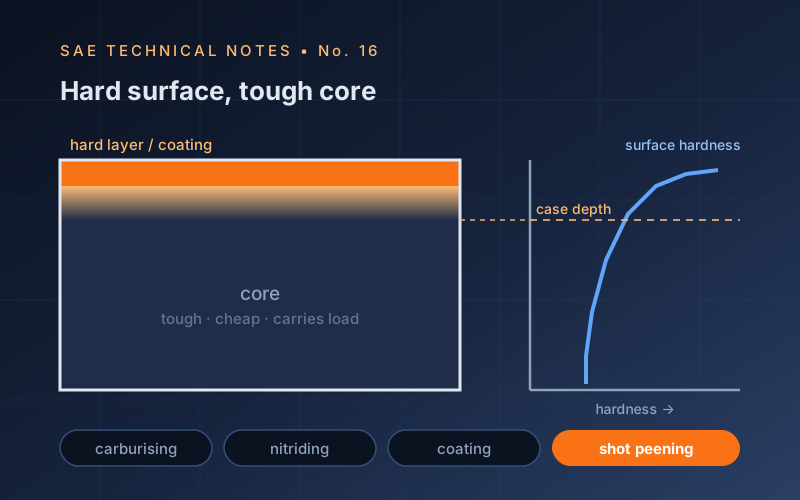
Almost everything that ends a component's service life begins at the surface: fatigue cracks nucleate there, wear removes it, corrosion advances from it. Strength, toughness and cost, on the other hand, are the business of the core. Surface engineering exploits that split: a cheap, tough core carrying a thin hard layer only where it is needed — cheaper than making the whole section from an expensive alloy, and usually safer, because hardening throughout lowers toughness.
What this note covers
- The three families: conversion, added layers and mechanical treatments
- Case hardening: induction, flame, carburising, nitriding, nitrocarburising, boriding
- Electroplating, electroless nickel (Ni-P) and anodising — differences in coverage
- Thermal spray and PVD/CVD; line-of-sight and temperature constraints
- Shot peening and the fatigue life gained from compressive residual stress
- Hydrogen embrittlement and the mandatory post-plating bake
- How coatings change fatigue strength — which help and which hurt
- Thickness, adhesion and case depth measurement; a selection guide
Why Treat the Surface at All?
Most component failures begin at the surface: wear, corrosion and fatigue cracks all start there. Surface engineering lets a design use a tough, inexpensive, machinable core and buy exactly the surface property it needs — hardness, corrosion resistance, low friction, appearance or electrical behaviour — without paying for it through the whole section.
Families of Treatment
| Family | Examples | Typical thickness | Buys |
|---|---|---|---|
| Diffusion | Carburising, nitriding, boriding | 0.05–2 mm | Hardness and fatigue strength, metallurgically bonded |
| Electrochemical | Zinc plating, hard chromium, electroless nickel | 5–100 µm | Corrosion protection, wear resistance, dimensional repair |
| Conversion | Anodising, phosphating, passivation | 2–50 µm | Corrosion resistance, paint and lubricant adhesion |
| Thin film (PVD/CVD) | TiN, CrN, DLC, TiAlN | 1–5 µm | Very high hardness, low friction, tool life |
| Thermal spray | HVOF WC-Co, plasma ceramics | 50–500 µm | Heavy wear resistance, rebuilding worn parts |
| Mechanical | Shot peening, deep rolling, burnishing | Affects 0.1–1 mm | Compressive residual stress — fatigue life |
| Organic | Paint systems, powder coating | 20–500 µm | Barrier corrosion protection, appearance |
Sacrificial or Barrier? The Decision That Matters
A sacrificial coating (zinc on steel, galvanising) is less noble than the substrate: when it is scratched it keeps protecting the exposed steel cathodically. A barrier or noble coating (nickel, chromium, most paints) protects only while it is intact; a pore or a scratch concentrates attack on the small exposed anode and perforation is faster than on bare steel. For parts that will be handled, assembled or stone-chipped, this single choice decides service life — and it is why decorative chromium is always plated over nickel over copper, as a system rather than a layer.
Effect on Fatigue — Which Way Does the Coating Push?
Surface treatment is never neutral for fatigue. Nitriding, carburising, induction hardening, shot peening and deep rolling introduce compressive residual stress and raise fatigue strength substantially. Hard chromium plating and some thermal sprays introduce tensile residual stress and microcracks and can reduce fatigue strength by 20–40%; where chromium is required on a dynamically loaded part, shot peening before plating is the standard compensation. Grinding after hardening can undo everything if it burns the surface — a grinding burn replaces compressive stress with tensile and is routinely the root cause in fatigue failures of ground, hardened parts.
Preparation Decides Adhesion
Nearly every coating failure is an adhesion failure, and nearly every adhesion failure is a preparation failure. The chain is degrease, clean, activate and coat without delay: alkaline or solvent degreasing, acid pickling or abrasive blasting to a defined profile (ISO 8501 surface preparation grades for steel), and a controlled interval before coating so the fresh surface does not re-oxidise. A coating applied on oil, scale or flash rust is a coating already failed; no later inspection can fix it.
Specific Processes Worth Knowing
- Hot dip galvanising (ISO 1461): thick zinc and iron–zinc layers, sacrificial, decades of outdoor life; distortion and bath temperature limit thin and complex parts.
- Anodising (ISO 7599): a thickened aluminium oxide grown from the substrate itself; hard anodising reaches 400–500 HV and 25–100 µm, and sealing is what makes it corrosion resistant.
- Electroless nickel: uniform thickness even in bores and blind holes, with hardness that rises further on heat treatment — the choice for complex geometry.
- PVD/CVD: CVD runs hot (800–1000 °C) and is used on carbide tools; PVD runs cool (200–500 °C) and suits hardened steel without re-tempering it.
- HVOF thermal spray: dense, well-bonded carbide coatings, the accepted alternative to hard chromium for wear and repair.
Specifying and Inspecting
- Thickness: magnetic induction and eddy current gauges (ISO 2178 / 2360), or a cross section for arbitration; state where it is measured, because recesses always plate thinner.
- Adhesion: cross-cut, bend, thermal shock or pull-off tests as appropriate to the coating.
- Corrosion: salt spray (ISO 9227) ranks, cyclic tests predict; agree the test, the hours and the acceptance criterion in writing.
- Hardness and case depth: microhardness traverse on a prepared section (EN ISO 18203), with the depth criterion named.
- On the drawing: the process, the standard, the thickness class, the required pre- and post-treatments (shot peening, baking) and the measuring position — all five, or the supplier will choose for you.
The technical note below (A4 PDF, in Turkish) develops these subjects in depth with original diagrams prepared for this series.