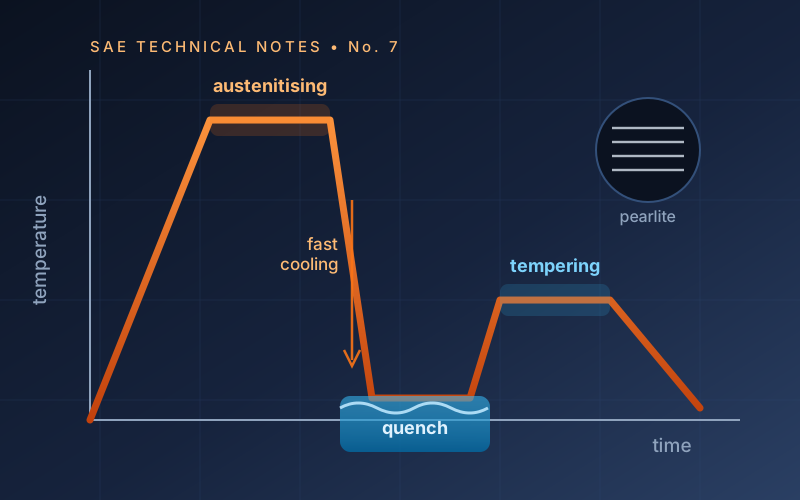
Heat treatment changes the microstructure — and therefore the mechanical properties — of a metal in the solid state through controlled heating and cooling, without altering its chemical composition. The same steel can be made soft and machinable or extremely hard and brittle purely by changing the cooling rate. For this reason a material designation alone is not sufficient: it must be given together with the delivery condition and the target hardness range.
What this note covers
- Transformation temperatures (A1, A3, Acm), austenitising, grain growth and decarburisation
- Cooling rate and transformation products: pearlite, bainite, martensite; CCT/TTT logic
- Quenching media, the Grossmann H factor, soft spots and quench cracking
- Hardenability and the Jominy end-quench test; section size versus steel selection
- Tempering, quench & temper, and the two distinct temper embrittlement ranges
- Surface hardening: carburising, carbonitriding, nitriding, induction hardening
- Root causes of heat treatment defects, quality control and documentation
What Heat Treatment Actually Changes
Heat treatment does not change the chemistry of a steel; it changes the microstructure that the chemistry is allowed to form. The chain is short and unforgiving: composition plus cooling rate decide the microstructure, and the microstructure decides the properties. Every practical question — why a part came out soft, why it cracked, why the core is weaker than the surface — is answered somewhere along that chain.
Austenitising
Hardening starts by heating above the transformation temperature (Ac3 for hypoeutectoid steels) and holding long enough to dissolve the carbides and homogenise the austenite — but no longer, because austenite grain growth costs toughness. Two side effects need control: decarburisation, which leaves a soft, fatigue-weak surface layer, and oxidation. Protective atmospheres, vacuum furnaces or salt baths are chosen for exactly this reason, and a machining allowance is the mechanical insurance.
Cooling Rate and Transformation Products
| Product | Forms when | Typical hardness | Character |
|---|---|---|---|
| Ferrite + pearlite | Slow cooling (furnace, air) | 150–250 HV | Soft, ductile, machinable |
| Bainite | Intermediate cooling or isothermal hold | 300–450 HV | Good toughness-to-strength ratio, low distortion |
| Martensite | Cooling faster than the critical rate | 500–700 HV (carbon dependent) | Hard and brittle as quenched — must be tempered |
A CCT diagram is the map of these outcomes for one specific steel. Martensite hardness is set almost entirely by carbon content; alloying elements mainly buy time — they shift the curves to the right so martensite can be reached with a gentler quench.
Quenching Media
Severity rises from still air through oil and polymer solutions to agitated brine. The engineering decision is always a trade: the fastest medium that achieves the required hardness, and no faster, because quenching stresses scale with severity. Quench cracks are a design problem as much as a process problem — sharp corners, abrupt section changes, unradiused keyways and delayed tempering produce them.
Hardenability and the Jominy Test
Hardenability is not hardness. It is the depth to which hardness can be achieved, and it is measured by the Jominy end-quench test (ASTM A255 / ISO 642): one end of a standard bar is water sprayed and hardness is traversed along its length. A steel with poor hardenability can be perfectly hard on a 10 mm sample and disappointing in a 60 mm shaft — the familiar mass effect. This is why section size must be stated when a steel is selected, and why a hardness specification should name the depth at which it applies.
Tempering and the Quenched-and-Tempered Condition
Tempering trades hardness for toughness in a controlled way: carbon leaves the supersaturated martensite as fine carbides, internal stresses relax, and ductility returns. Low tempering (150–250 °C) keeps hardness for wear applications; high tempering (550–650 °C) gives the quenched-and-tempered condition used for shafts and structural components. Two embrittlement ranges are avoided deliberately: tempered martensite embrittlement around 250–400 °C, and temper embrittlement from slow cooling through roughly 375–575 °C in susceptible alloy steels.
Surface Hardening
| Process | Temperature | Case | Surface hardness | Suitable steel |
|---|---|---|---|---|
| Carburising | 880–950 °C | 0.3–2 mm, carbon enriched | 58–62 HRC | Low carbon case-hardening steels (16MnCr5, 18CrNiMo7-6) |
| Nitriding | 500–550 °C | 0.1–0.6 mm, nitride layer | 900–1200 HV | Nitriding steels (31CrMoV9), pre-hardened |
| Induction hardening | Local, above Ac3 | 1–5 mm, unchanged chemistry | 50–60 HRC | Medium carbon steels (C45, 42CrMo4) |
Nitriding deserves its reputation for dimensional stability: it runs below the transformation temperature, so there is no quench and little distortion — at the cost of a thin case and long cycle times.
Common Failures and Their Root Causes
- Soft part: austenitising temperature or time too low, quench too slow for the section, decarburised surface, or the wrong steel supplied — verify with chemistry and a hardness traverse.
- Distortion: asymmetric section, prior machining stresses not relieved, uneven quenching.
- Cracking: severe quench, delayed tempering, stress raisers in the design.
- Soft spots: vapour blanket in the quench, fixture shadowing, scale on the surface.
Documentation and Control
A heat treatment specification is only verifiable if it states the condition, the hardness, where that hardness is measured, and the case depth criterion (EN ISO 2639 / EN ISO 18203). Furnace surveys and process control — CQI-9 in the automotive supply chain — exist because the same written recipe can produce different parts in two different furnaces.
The technical note below (A4 PDF, in Turkish) develops these subjects in depth with original diagrams prepared for this series.