Tribology is the science of surfaces in relative motion: friction, wear and lubrication. Its most misunderstood point is this — the friction coefficient and the wear rate are properties of the system, not of the material. Young's modulus is a material constant; there is no such constant as "the wear resistance of steel". The same steel pair can change its wear rate a thousandfold when load, speed, temperature, lubricant or environment change. The first job in any wear problem is therefore to identify which mechanism is operating.
What this note covers
- Friction laws and the real area of contact — why Amontons works and where it fails
- Six wear mechanisms: adhesive, abrasive, surface fatigue, tribochemical, fretting, erosion
- The Archard equation and specific wear rate k; mild versus severe wear
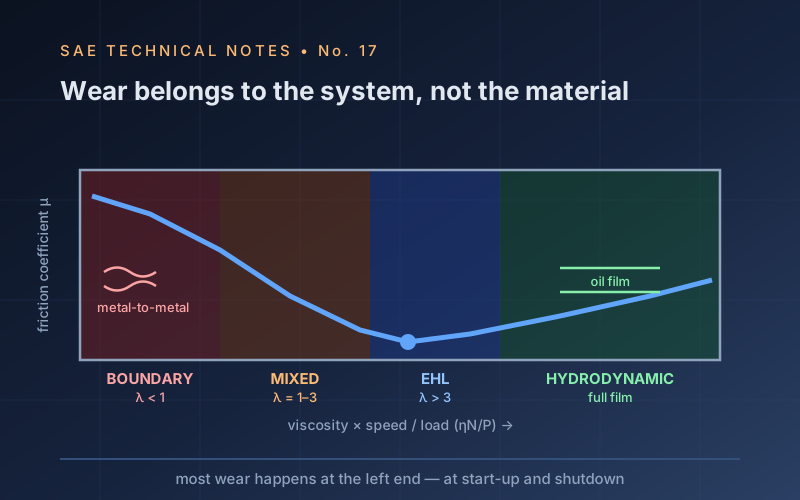
- The Stribeck curve: boundary, mixed, EHL and hydrodynamic regimes
- The film parameter λ — smooth the surface or thicken the oil?
- Oil and grease selection: viscosity, ISO VG / SAE / NLGI, additives and the EP–bronze conflict
- Surface roughness: why Ra is not enough, skewness and plateau honing
- Wear testing and predictive maintenance through oil analysis (ISO 4406, trending)
Wear Is a System Property, Not a Material Property
No material has a wear rate. A tribological system has one: two surfaces, the load and motion between them, the lubricant or atmosphere, the temperature and any third body (debris, dust, abrasive) caught in the contact. Change the counterface or the lubricant and the same steel can last ten times longer or fail in an afternoon. This is why wear data must always be read together with the conditions it was measured under.
Friction in One Sentence
Real surfaces touch only at asperity peaks, so the true contact area is a small fraction of the apparent area and it grows with load — which is why friction force is roughly proportional to load and almost independent of apparent area. Friction has two contributions: shearing of the junctions formed at those contacts, and ploughing of the softer surface by the harder one.
The Four Wear Mechanisms
| Mechanism | How it is recognised | Driven by | Countermeasure |
|---|---|---|---|
| Adhesive | Material transferred from one surface to the other, scuffing, galling | Similar materials, inadequate film, high local temperature | Dissimilar pairing, surface coatings, EP additives |
| Abrasive | Parallel grooves in the sliding direction | Hard particles or a hard rough counterface | Hardness above the abrasive, filtration, sealing |
| Surface fatigue | Pitting and spalling after many cycles | Rolling contact stress (bearings, gears) | Cleaner steel, correct hardness and film thickness, lower contact stress |
| Tribochemical | Oxide debris, fretting marks, red dust at fits | Small-amplitude motion plus oxidation | Eliminate micro-movement, change preload, apply solid lubricant |
Archard’s equation, V = k·F·s/H, captures the first-order trend for adhesive and abrasive wear: volume lost rises with load and sliding distance and falls with hardness. It is a scaling rule, not a design formula — k itself depends on the whole system.
Lubrication Regimes and the Stribeck Curve
Plotting friction against the group (viscosity × speed / load) gives the Stribeck curve and three regimes:
- Boundary lubrication — surfaces in asperity contact, protection comes from chemically adsorbed additive films. This is start-up, reversal points and slow heavy loading: where most wear happens.
- Mixed — part film, part contact; friction falls steeply.
- Hydrodynamic / elastohydrodynamic (EHL) — a full film separates the surfaces and friction comes only from shearing the fluid. In concentrated contacts (gears, rolling bearings) the pressure raises viscosity by orders of magnitude and elastically flattens the surfaces, which is what makes a film of a fraction of a micrometre possible.
The decisive design number is the lambda ratio: film thickness divided by composite surface roughness. Below about 1 the contact runs boundary; above about 3 it is fully separated. Roughness is therefore as much a design variable as viscosity — a smoother surface can do what a heavier oil cannot.
Lubricants and Additives
Mineral and synthetic base oils are classified by viscosity grade (ISO VG) and by viscosity index, which describes how little viscosity changes with temperature. Additives do the work the base oil cannot: anti-wear (ZDDP), extreme pressure (sulphur and phosphorus compounds for boundary contacts), antioxidants, detergents and dispersants, and friction modifiers. Greases are oil held in a soap thickener and are used where sealing or re-lubrication is impractical. Solid lubricants — graphite, MoS2, PTFE — cover vacuum, extreme temperature and food-contact cases where oil cannot be used.
Oil analysis is condition monitoring: viscosity change, oxidation, water content and especially wear particle counts tell what is happening inside the machine long before vibration does.
Material Pairing
Identical metals in sliding contact weld and gall; that is the first rule of pairing. Classical combinations — hardened steel against bronze, steel against grey cast iron, steel against polymer — work because one partner is sacrificial, embeds debris, or forms a protective transfer film. Grey iron performs well because its graphite flakes act as a built-in solid lubricant. Polymers (PTFE, PEEK, UHMWPE) run dry and quietly but are limited by the PV (pressure × velocity) product and by creep.
Surface Engineering Against Wear
- Case hardening, nitriding, induction hardening: hard surface, tough core, and compressive residual stress that helps fatigue as well as wear.
- Thermal spray and hardfacing: thick, rebuildable layers (WC-Co, chromium carbide) for heavy abrasion.
- Thin hard coatings (PVD/CVD): TiN, CrN, DLC — a few micrometres, very hard, low friction; they demand a hard substrate, since a hard shell on a soft core collapses.
- Texturing and run-in: controlled micro-dimples retain lubricant; a correct run-in procedure conforms the surfaces before full load is applied.
Diagnosing a Worn Part
Read the surface before changing anything: parallel grooves mean abrasion (find the particle source — seal, filter, or debris from another failure); smeared and transferred metal means adhesion and a failed film; pits with sharp edges after many cycles mean contact fatigue; red-brown powder at a fit means fretting, so look for micro-movement and insufficient clamping. The wear scar names the mechanism, and the mechanism — not the catalogue — selects the remedy.
The technical note below (A4 PDF, in Turkish) develops these subjects in depth with original diagrams prepared for this series.