Forging shapes metal into the desired geometry through plastic deformation under compressive forces. Thanks to the fiber structure formed as the grains align during deformation, forged parts offer superior mechanical properties and fatigue strength compared to their cast counterparts — making forging the first choice for safety-critical parts in aviation and automotive.
What this note covers
- Comparison of hot, warm and cold forging processes
- Open-die and closed-die forging; precision forging applications
- Die design, flash formation and management of material flow
- Post-forging heat treatment and microstructure control
Why Forge At All?
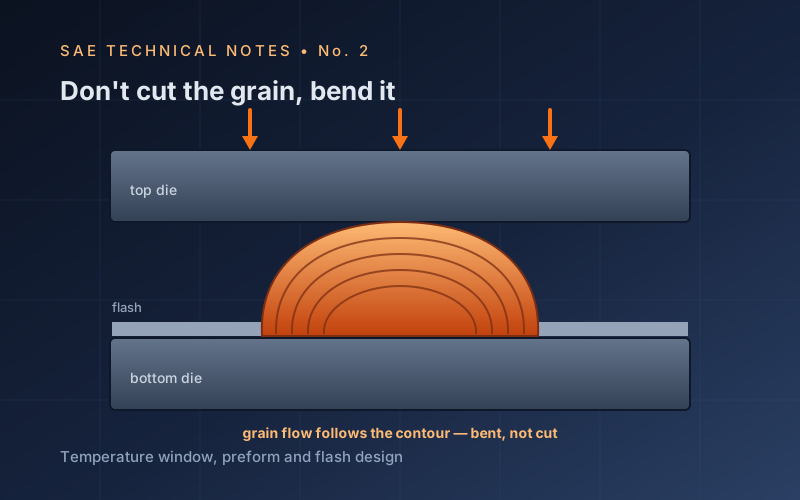
Machining a part from bar stock cuts straight through the grain flow of the material; forging bends that flow so it follows the contour of the part. The difference does not show in a tensile test of the raw material — it shows at the fillet of a loaded component, where a continuous fibre carries the stress and a cut fibre offers a ready path for a crack. Forging also closes residual porosity from the ingot and refines the grain through recrystallisation, which is why safety-critical parts (crankshafts, connecting rods, steering and suspension components, aerospace fittings) are forged rather than cut.
Hot, Warm and Cold Forging
The working temperature is chosen against the homologous temperature T/Tm, and it fixes three things at once: the force required, the achievable tolerance and the final microstructure.
| Route | Typical range in steel | Advantage | Limitation |
|---|---|---|---|
| Cold | Room temperature | Best tolerance and surface, work hardening adds strength | Highest force, limited deformation per step, interstage annealing |
| Warm | 650–900 °C | Compromise: lower force than cold, better tolerance than hot | Narrow window, scale and lubrication are demanding |
| Hot | 1100–1250 °C | Lowest flow stress, large shape change in one blow | Scale, coarse tolerance, risk of grain coarsening |
The upper limit is not negotiable: above roughly 1300 °C the grain coarsens and grain boundaries begin to oxidise and partially melt — the classic burnt structure, which no later heat treatment can repair. The lower limit is an equipment problem: flow stress rises, the press and dies are overloaded, and underfill or cracking follows.
Open Die, Closed Die, Press or Hammer
Open-die forging works the material between simple tools and suits one-offs and very large pieces; closed (impression) die forging fills a cavity and suits series production. A hammer delivers energy quickly, works the surface layers strongly and is forgiving of thin sections; a press delivers a controlled stroke, works the core more uniformly and is easier to automate. Hydraulic presses allow slow, controlled deformation where the alloy is strain-rate sensitive — titanium and nickel alloys in particular.
Die and Preform Design
The impression is only part of the tool. A flash land restricts the escape of material and builds the back pressure that forces the cavity to fill; the flash gutter then receives the excess. Too wide a land means excessive load and die wear, too narrow means underfill. Draft angles, generous fillets and a parting line placed where it least disturbs the fibre complete the layout.
The preform (blocker) stage distributes the volume before the finishing blow. Most lap defects are born here: if the preform forces metal to fold back on itself around a sharp radius, the fold closes into an oxidised seam that cannot be welded shut by further forging. Finite-element simulation of material flow is now the standard way to prove a preform before cutting steel.
Process Parameters That Decide Quality
- Billet heating: induction heating is the series-production standard — fast, little scale, easy to automate. Temperature uniformity matters as much as the set point.
- Scale control: scale carried into the die prints into the surface; descaling and short transfer times are part of the process, not housekeeping.
- Lubrication: graphite–water emulsions in hot forging act as both die coolant and release agent; phosphate plus soap is the classic cold forging system.
- Die preheat: 150–300 °C. A cold die cracks early and promotes cold shuts.
Defects: Diagnosis and Prevention
| Defect | Appearance | Root cause | Prevention |
|---|---|---|---|
| Lap / fold | Oxidised seam parallel to the surface; linear indication in MT/PT | Metal folded onto itself: poor preform, sharp radius | Preform revision, larger radii, flow simulation |
| Underfill | Unfilled corners of the impression | Insufficient volume or energy, low temperature, flash escaping too freely | Billet volume, narrower flash land, temperature control |
| Pipe / centre looseness | Discontinuity at the centre, found by UT | Ingot shrinkage not closed by a sufficient reduction ratio | Reduction ratio ≥ 3:1, qualified semi-finished product |
| Burning / hot tear | Oxidised cracks along grain boundaries | Overheating, sulphur effects | Heating control, correct temperature window |
| Decarburisation | Soft ferritic surface layer | Long or oxidising heating | Rapid induction heating, atmosphere control, machining allowance |
| Quench crack | Sharp, clean intergranular crack after hardening | Severe quench plus delayed tempering, abrupt section changes | Milder medium (oil, polymer), temper immediately |
Inspection and Standards
- Dimensional tolerances for steel drop forgings to EN 10243; a first-article layout before series release.
- Magnetic particle or penetrant testing for surface indications; ultrasonic testing for internal soundness.
- Macro etching for flow lines where fibre orientation is specified on the drawing.
- Hardness and microstructure after the post-forge heat treatment (normalising, or quench and temper).
The technical note below (A4 PDF, in Turkish) develops these subjects in depth with original diagrams prepared for this series.