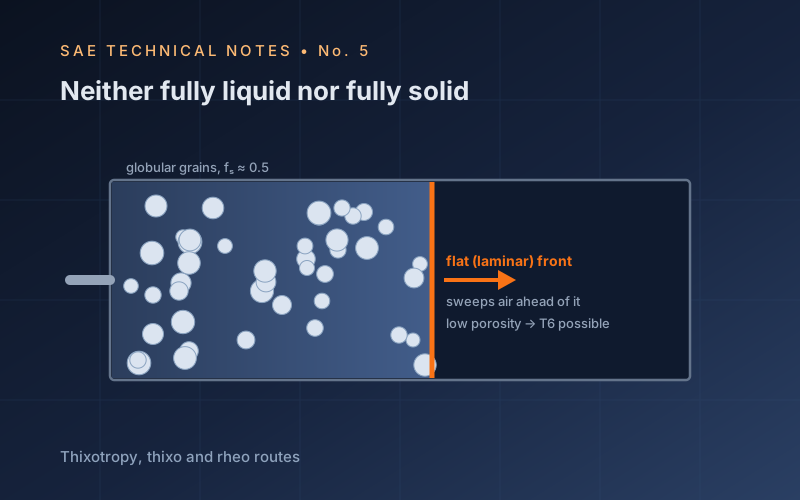
Semi-solid forming shapes metal as a slurry with a globular microstructure, in the temperature range between solid and liquid. Thanks to its thixotropic behavior, it delivers low porosity, tight tolerances and heat-treatable parts — a quality level conventional high pressure die casting cannot reach.
What this note covers
- Thixocasting and rheocasting processes
- Obtaining the globular microstructure and rheological behavior
- Applications in aluminum and magnesium alloys
- Effect of process parameters on mechanical properties
A Bridge Between Casting and Forging
Semi-solid forming shapes metal in the mushy state — typically with a solid fraction around 0.4 to 0.6 — instead of fully liquid or fully solid. The material behaves like a thixotropic paste: it holds its shape when left alone, yet flows readily when sheared. The result is a part filled without turbulence, with far less porosity than pressure die casting and at a fraction of the force needed for forging.
The Science: Thixotropy and Globular Structure
The key is the shape of the solid particles. A normally solidifying alloy grows dendrites — branched crystals that interlock into a skeleton at as little as 20% solid; such a slurry cannot be shaped. If the growing crystals are forced to become globular (by stirring, controlled cooling or shear), they can roll over one another: viscosity drops by orders of magnitude under shear and recovers at rest. That is thixotropy, and it is the entire basis of the process.
Process Routes
Thixocasting is a two-stage route. A special billet with globular structure is produced in a casting plant, usually by magnetohydrodynamic (MHD) stirring. In the forming plant a slice is reheated by induction into the semi-solid range with great precision (for A356 roughly 577–585 °C) and injected into the die. It is the most stable and repeatable route; its drawbacks are the cost of the special billet and the fact that scrap cannot return to the route.
Rheocasting produces the slurry directly from the liquid in the forming cell: metal poured at low superheat is converted into a globular slurry by controlled cooling and nucleation management, then injected immediately. Commercial variants include NRC, SEED, GISS (gas bubbling) and SSR (rotating cooling rod). Because it uses standard ingot and tolerates returns, the industry has moved towards rheocasting.
Thixomolding is the metallic twin of plastic injection moulding: magnesium alloy granules (AZ91D) are partly melted in a heated screw barrel, where the shear of the screw produces the globular structure, and the machine injects directly into the die. It requires no magnesium holding furnace, which makes it attractive on safety grounds, and it is the standard for thin-walled electronics housings.
Why It Is Worth the Trouble
- Laminar filling: the viscous slurry advances as a flat front and sweeps air ahead of it, so entrapped gas and folded oxide films are dramatically reduced.
- Low porosity: the part becomes heat treatable (T5/T6) and weldable — the threshold conventional high pressure die casting cannot cross.
- Less shrinkage: part of the metal is already solid on entry, so contraction and distortion fall; tolerances tighten and machining allowances shrink.
- Kinder to the die: working 50–100 °C below the liquid route measurably extends die life against thermal fatigue.
- Properties: A356-T6 semi-solid parts exceed permanent mould castings in ductility and fatigue and approach forged properties.
Limitations
- A narrow process window: a few degrees change the solid fraction sharply, so precise temperature control is mandatory.
- Alloy choice: wide freezing range, eutectic-rich alloys are needed (A356 / A357 are ideal); narrow-range alloys are difficult.
- Equipment and know-how thresholds, and a part cost above conventional HPDC — the economics work where heat treatment, welding or pressure tightness are required.
Alloys and Applications
Aluminium Al–Si alloys (A356, A357) dominate, with magnesium AZ91D in thixomolding and some work on copper alloys and steels where die materials allow. Typical parts are automotive suspension and steering components, engine brackets, fuel-system and pressure-tight housings, electronic and telecom enclosures where thin walls and thermal conduction matter, and safety components that must be welded to a structure.
Defects and Quality Control
| Defect | Cause | Prevention |
|---|---|---|
| Coarse or dendritic structure | Incorrect reheating profile or insufficient stirring | Verify the thermal cycle; check the billet structure metallographically |
| Liquid segregation | Liquid separating from solid during filling | Gate design, injection speed, correct solid fraction |
| Cold shut | Solid fraction too high, slurry too cold | Temperature control within a few degrees |
| Blistering after T6 | Residual entrapped gas | Fill-regime and vacuum control; the classic sign that the process was not truly semi-solid |
Control therefore concentrates on three things: the temperature (and hence solid fraction) of the slurry, the globular structure verified on a metallographic section, and soundness confirmed by radiography or by the simplest practical test of all — a solution treatment that produces no blisters.
The technical note below (A4 PDF, in Turkish) develops these subjects in depth with original diagrams prepared for this series.