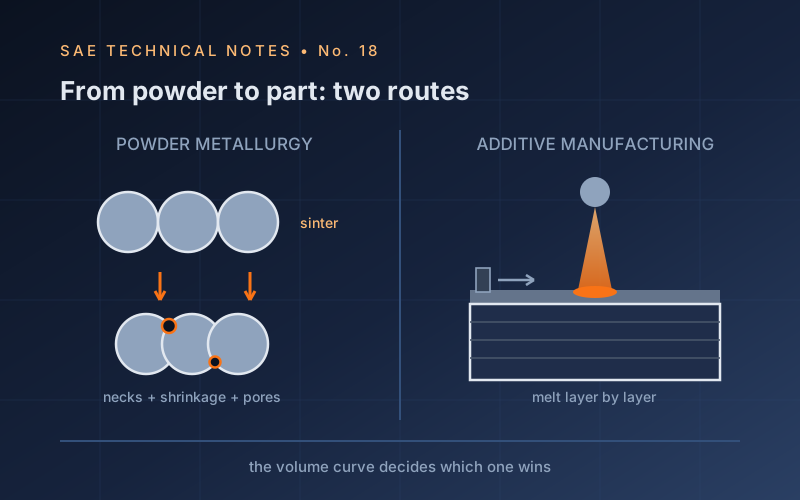
Most conventional manufacturing is subtractive: you start from a billet and cut away what you do not want. The two families in this note do the opposite — they build the part by joining particles. In powder metallurgy the powder is pressed in a die and sintered below the melting point; in additive manufacturing the same powder is melted layer by layer to the part geometry. One is not the modern version of the other: they live in different volume regimes, and the quantity curve decides which one wins.
What this note covers
- Powder production: water and gas atomisation, milling — the route sets particle shape, shape sets the use
- Powder specification: size distribution, flow, oxygen and number of reuse cycles
- Press and sinter: the three stages of sintering, shrinkage and the price of porosity
- Routes to full density: HIP, MIM, hot pressing, powder forging
- Metal AM families: PBF-LB, PBF-EB, DED, BJT and where each belongs
- Energy density E = P/(v·h·t); lack of fusion versus keyhole porosity
- AM microstructure: columnar grains, anisotropy, residual stress, surface roughness
- Design for AM (the 45° rule, powder escape), post-processing and qualification
Making Parts Without Melting Them
Powder metallurgy builds a component from metal powder: the powder is shaped, then bonded by diffusion below the melting point. Two advantages follow directly. First, the shape comes out close to final, so material utilisation is high and machining is minimal — decisive for expensive alloys. Second, combinations that melting cannot produce become possible: controlled porosity for self-lubricating bearings, tungsten carbide in a cobalt binder, and composites of materials that are mutually insoluble.
Powder Production Sets the Rules
The powder decides what the process can do. Gas atomisation gives clean spherical particles with excellent flow — the standard for additive manufacturing and hot isostatic pressing. Water atomisation is cheaper and gives irregular particles that interlock and therefore press into strong green parts — the standard for conventional press-and-sinter steel parts. Chemical and electrolytic routes serve special cases. The properties that matter in practice are particle size distribution, shape, flowability, apparent density, oxygen content and compressibility.
Shaping
- Die pressing: the classic route, 200–800 MPa in a rigid die. Fast and cheap, limited to shapes that can be ejected, with a density gradient caused by die wall friction.
- Metal injection moulding (MIM): fine powder plus a binder, injected like a plastic, then debound and sintered. Complex small parts at high density, with 15–20% linear shrinkage that must be designed for.
- Isostatic pressing: cold (CIP) for uniform green density in large or long parts; hot (HIP) applies pressure and temperature together and closes residual porosity completely.
- Additive manufacturing: laser or electron beam powder bed fusion, building the part layer by layer directly from powder.
Sintering: What Actually Happens
Sintering is diffusion driven by the reduction of surface energy, in three overlapping stages: necks form between touching particles; the necks grow and the pore network becomes continuous but shrinks; finally pores become isolated, spheroidise and — if the cycle allows — are partly eliminated. Shrinkage is real and must be designed into the tooling: typically 15–20% linear in MIM and a few percent in pressed steel parts.
Atmosphere is not a detail. Hydrogen, dissociated ammonia, nitrogen mixtures or vacuum reduce the oxides on the particle surfaces; without that reduction the necks never bond properly and the part is weak whatever the temperature. Liquid phase sintering — a minor constituent melting and wetting the solid skeleton — is what makes cemented carbide (WC-Co) and many copper-alloyed steels possible, giving near full density at modest temperatures.
Secondary Operations
Sizing and coining improve dimensions and surface finish; steam treatment produces a hard oxide layer and seals the surface of ferrous parts; infiltration with copper fills open pores and raises strength and machinability; impregnation with oil makes a self-lubricating bearing, and with resin makes a part pressure tight. Conventional heat treatment is possible, but with a caveat: open porosity lets quenching salts and atmospheres into the part, so processes and media are selected accordingly.
Additive Manufacturing: Powder Metallurgy at the Part Scale
In laser powder bed fusion the material is melted and solidified in a volume of fractions of a millimetre at cooling rates of 105–106 K/s. The consequences are characteristic: very fine, often columnar grains aligned with the build direction, anisotropic properties, and large residual stresses that distort parts and crack supports. Typical defects are lack of fusion between tracks, keyhole porosity from excessive energy density, and entrapped gas.
That is why the finished part is rarely the end of the process: stress relief before removal from the plate, HIP to close internal porosity, solution treatment and ageing where the alloy requires it, and machining of functional surfaces. Specifying an additive part therefore means specifying the build orientation, the post-processing route and the inspection method — not only the alloy.
Where It Is Used
Automotive sintered steel parts (synchroniser hubs, connecting rods, oil pump gears, valve seats), cemented carbide tooling, self-lubricating bronze bearings, filters with controlled porosity, friction materials, refractory metals (tungsten, molybdenum) that are impractical to cast, magnetic materials, and aerospace titanium and nickel superalloy parts where buy-to-fly ratio dominates the cost.
Quality Control and Standards
- Powder: particle size (ISO 4497), apparent density (ISO 3923), flow rate (ISO 4490), compressibility (ISO 3927), chemistry and oxygen content.
- Part: density and open porosity (ISO 2738), transverse rupture strength (ISO 3325), hardness with the porosity correction in mind, metallographic assessment of pore size and distribution.
- Additive parts: CT scanning for internal porosity, tensile specimens built in each orientation, powder reuse and traceability records.
The technical note below (A4 PDF, in Turkish) develops these subjects in depth with original diagrams prepared for this series.