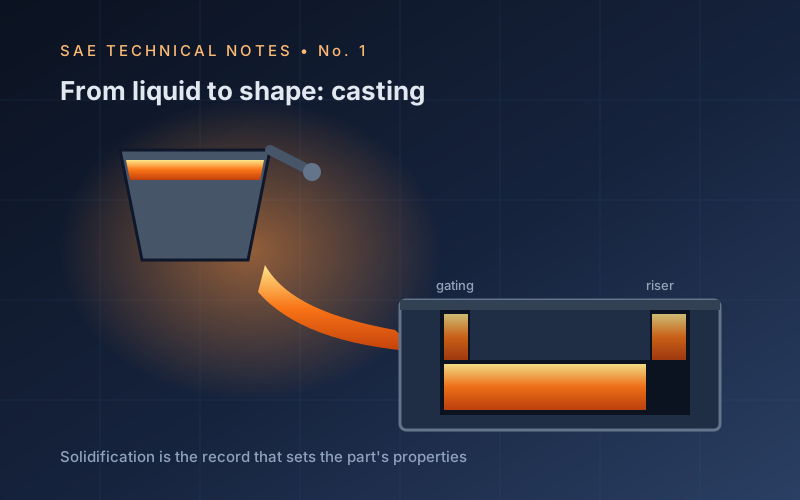
Casting is one of the oldest and most widely used manufacturing methods, based on pouring molten metal into a mold cavity of the desired geometry and letting it solidify. The ability to produce complex geometries in a single, economical operation makes casting indispensable from automotive to the defense industry.
What this note covers
- Sand casting, permanent mold casting and high pressure die casting (HPDC)
- Solidification metallurgy: nucleation, grain structure and the effect of cooling rate
- Gating and riser design; prevention of shrinkage cavities
- Casting defects: porosity, inclusions, cold shuts and analysis methods
Process Families: Choosing the Right Route
Casting processes differ mainly in how the mold is made, how fast the metal solidifies and how many parts the tooling has to pay for. The mold is either expendable (destroyed to free the part) or permanent (reused thousands of times), and that single distinction drives cost, tolerance and achievable microstructure.
| Process | Mold | Typical tolerance | Economic batch | Where it wins |
|---|---|---|---|---|
| Sand casting | Expendable (green sand, resin-bonded) | Coarse (EN ISO 8062 DCTG 11–13) | 1 – 10,000 | Large parts, cored geometries, low tooling cost |
| Investment casting | Expendable ceramic shell | Fine (DCTG 5–7) | 100 – 50,000 | Thin walls, near-net shape, superalloys |
| Permanent mold (gravity die) | Metallic, reused | Medium (DCTG 7–9) | 1,000 – 100,000 | Aluminium parts needing a sound, heat-treatable structure |
| High pressure die casting (HPDC) | Metallic, reused | Fine (DCTG 5–7) | 10,000 + | Thin-wall, high-volume aluminium and magnesium |
| Centrifugal casting | Metallic or lined | Medium | Varies | Rotationally symmetric parts; lighter inclusions pushed inward |
Solidification: Where Properties Are Decided
A casting is not simply metal that has taken a shape; it is a record of its own solidification. Nucleation and growth during freezing set grain size, segregation and porosity, and these are far harder to repair afterwards than to get right the first time.
Grain structure across the section
Against the cold mold wall, rapid undercooling produces a thin chill zone of fine, randomly oriented grains. Inward from it, grains whose favourable crystallographic direction is aligned with the heat flow outgrow their neighbours and form the columnar zone. In the thermal centre, where the gradient is shallow, free nuclei survive and an equiaxed zone forms. Grain refiners and controlled cooling widen the equiaxed region, which is usually desirable: columnar grains meeting head-on at a corner create a weak plane.
Cooling rate and dendrite arm spacing
In aluminium alloys the secondary dendrite arm spacing (SDAS) follows the local solidification time, and mechanical properties follow SDAS. Two castings with identical chemistry and identical heat treatment can differ substantially in elongation simply because one section cooled more slowly. Section thickness is therefore a metallurgical decision, not only a stress calculation.
Gating and Feeding
The gating system has one job: to deliver clean metal into the cavity without turbulence. Turbulent metal entrains air and folds its own oxide film into the melt; in aluminium these folded films (bifilms) act as ready-made cracks. A tapered sprue, a well, a runner that stays full and a correctly sized ingate all exist to keep the stream compact.
Feeding is a separate problem. Nearly all metals shrink on solidifying — roughly 3–7% by volume for steels and aluminium alloys — so the last liquid must come from a reservoir. A riser works only if it satisfies two conditions: it must freeze later than the section it feeds, and it must keep a continuous liquid path to it. Chvorinov’s rule, t = B(V/A)n, expresses the first condition through the modulus (volume-to-surface ratio); insulating sleeves and exothermic compounds raise a riser’s effective modulus without enlarging it.
Reading Defects Correctly
Most casting disputes start with a defect being named wrongly, because the wrong name leads to the wrong remedy — degassing will never cure a feeding problem. The diagnosis is made from the internal surface of the cavity and from where in the section it sits.
| Indication | Internal surface | Location | Root cause | Remedy |
|---|---|---|---|---|
| Shrinkage cavity | Rough, dendritic, jagged | Thermal centre, last to freeze | Inadequate feeding, wrong modulus | Riser and chill design, directional solidification |
| Gas porosity | Smooth, rounded, often shiny | Dispersed, frequently subsurface | Dissolved hydrogen, damp mold, lubricant | Degassing, dry charge materials, melt control |
| Slag / dross inclusion | Filled with a dark, irregular phase | Near the upper surface or the ingate | Oxide and slag carried in with the stream | Filters, non-turbulent gating, careful skimming |
| Cold shut | Oxidised seam, smooth boundary | Where two flow fronts met | Low pouring temperature, long fill path | Temperature and fill-time control, larger ingate |
| Hot tear | Oxidised, intergranular crack | Sharp corners, restrained sections | Contraction restrained while still mushy | Generous radii, collapsible cores, alloy choice |
Quality Control and Standards
- Chemistry: spectrometric analysis per heat, with grain refiner and modifier additions logged.
- Melt quality (aluminium): reduced-pressure test for hydrogen; filtration and degassing records.
- Soundness: radiography assessed against reference radiographs (ASTM E155 for aluminium, ASTM E446/E186 for steel); ultrasonic testing for heavy sections; penetrant testing for surface indications.
- Dimensions: tolerances and machining allowances to EN ISO 8062; a first-article layout before series release.
- Documentation: inspection certificate to EN 10204 (3.1 where traceability matters); general technical delivery conditions for steel castings to EN 1559-1/-2.
The practical rule behind all of this: a casting result describes that casting, produced under those conditions. Chemistry alone never guarantees properties — the solidification history does.
The technical note below (A4 PDF, in Turkish) covers these subjects in depth with original diagrams of the gating system, the macro grain zones and the three cavity types.